Showing posts with label emulation. Show all posts

Monday, 6 June 2022

CentOS 4 on PCem Pentium 75 - System Information

CentOS 4.0 GNOME desktop on a PCem Pentium 133

CentOS

CentOS was a freely available version of Red Hat Enterprise Linux (RHEL), which followed the upstream RHEL updates and removed any non-free IP from the packages.

Red Hat developed a commercial Linux in the form of Red Hat Linux (also known as Red Hat Commercial Linux), which developed a stable long term support distribution in the form of Red Hat Enterprise Linux (RHEL), which includes components not covered by free licenses. To provide a community Linux which wasn't constrained by enterprise concerns, the Red Hat Linux line was replaced with Fedora Linux. Fedora Linux provides a Red Hat style distribution nearer the bleeding edge than RHEL and isn't encumbered by non-free licenses. This change meant that many users were faced with a decision... to switch to Fedora and cope with the more dynamic nature of the project, or pay for RHEL to get long term stability.

Since RHEL was based on opensource, a number of projects sprung up that took the free parts of RHEL, removed any branding or other encumbered property, and repackaged them into new distributions (see Red Hat Enterprise Linux derivatives - Wikipedia). CentOS was one of these projects and provided an RHEL compatible distribution that lagged a little bit behind RHEL release and updates, and was freely available. While CentOS has since been acquired by Red Hat, and its role (as CentOS Stream) has changed to being upstream of RHEL, we're going to be looking at a version from not long after Red Hat Linux was discontinued.

CentOS 4

RHEL 4 was released on 15-Feb-2005 and was based on Fedora Core 3 (8-Nov-2004). With the corresponding CentOS 4 being released a little later on 9-Mar-2005. Based on the Linux 2.6 kernel (see Introducing the 2.6 Kernel | Linux Journal), this was a jump from previous RHEL and CentOS releases which had used the Linux 2.4 kernel.

Older CentOS releases are available for download from: https://wiki.centos.org/Download.

Friday, 27 May 2022

Linux for ARM on QEMU (virt) - System Information

Linux for ARM

Processor designs from Arm Ltd. are used in a plethora of microprocessors and SoC (System on a Chip) components. Which power a wide range of devices including: smartphones, tablets, PDAs, network routers, NAS systems, set-top boxes, etc. Some (non-exhaustive) lists of devices using the ARM architecture can be found in:

The initial port of the Linux kernel to ARM began back in 1994, then targeting an Acorn A5000 running RISCOS, and grew from there through to being part of the mainline Linux kernel.

The use of ARM cores in microprocessors, microcontrollers and SoC devices, for many different vendors, meant that supporting Linux on a device would often require a specific kernel built for that specific device. This limited the availability of general purpose Linux distributions, while making vendor specific embedded Linux kernels common. Fortunately since most user-space applications use the kernel abstractions to access devices, the same user-space can be used with any kernel built for the same flavor of the architecture (see ArmPorts - Debian Wiki).

Support for a selection of ARM based systems ('arm') appeared in the Debian GNU/Linux 2.2 (`potato') release in 2000. The current Debian Linux 11 (bullseye) supports ARM through the 'armel', 'armhf' and 'arm64' (aka. 'aarch64') ports.

QEMU

The diversity of devices using the ARM processor means the QEMU system emulators for ARM provide a large number of emulated systems, with the QEMU 5.2.0 build I'm using listing 90 systems for the 64-bit system emulator (qemu-system-aarch64), and 84 for the 32-bit system emulator (qemu-system-arm). While most systems appear in the lists for both emulators (suggesting they could be implemented with 32-bit or 64-bit processor cores) a small set of systems are 64-bit only.

While most of the available systems correspond to physical hardware, the "QEMU ARM Virtual Machine" system ('virt') is a virtual system based on the use of paravirtualized devices. This provides performance improvements, particularly for I/O, and is useful for software development and testing, for cases where specific hardware features are not required.

Wednesday, 25 May 2022

RedHat Linux 7.3 (Valhalla) on PCem Pentium 75

Red Hat Linux 7.3 GNOME desktop

RedHat Linux

Initially established back in 1994, Red Hat (Wikipedia) is a commercial Linux vendor known for the RedHat Linux, Red Hat Enterprise Linux (RHEL) and Fedora Linux distributions.

RedHat Linux 7.3 (Valhalla) was released in 2002, and supported i386 through early Pentium 4 systems (the Intel Core based processors didn't ship until 2006). So it is suitable for comparing our physical Intel Pentium system (tilia) and the PCem emulated equivalent.

Earlier Releases

A couple of earlier Red Hat Linux releases are described on the same PCem system in:

It is interesting to see the evolution of the Red Hat Linux distribution over these releases.

PCem

The IBM PC and compatibles emulator PCem supports a range of PC system, from the original Intel 8088 based IBM PC through to a early 2000s slot 1 based Pentium II system. This includes a couple of systems featuring the Intel 430fx chipset which makes them equivalent to our physical system.

So the target emulated hardware is:

MainboardIntel Advanced/ZP (Zappa); Intel Triton 82430FX PCIset aka. 430FX
CPUIntel Pentium 75
RAM72 MiB (128 MiB max.)
Floppy3.5" 2.88MB
StorageIDE Controller Intel 82371FB aka. PIIX, ATA-2 16 MB/s
IDE hard disk 2048 GB
ATAPI CD-ROM drive
VideoS3 Trio64 based VGA
Network10Mb/s ethernet ISA

Monday, 23 May 2022

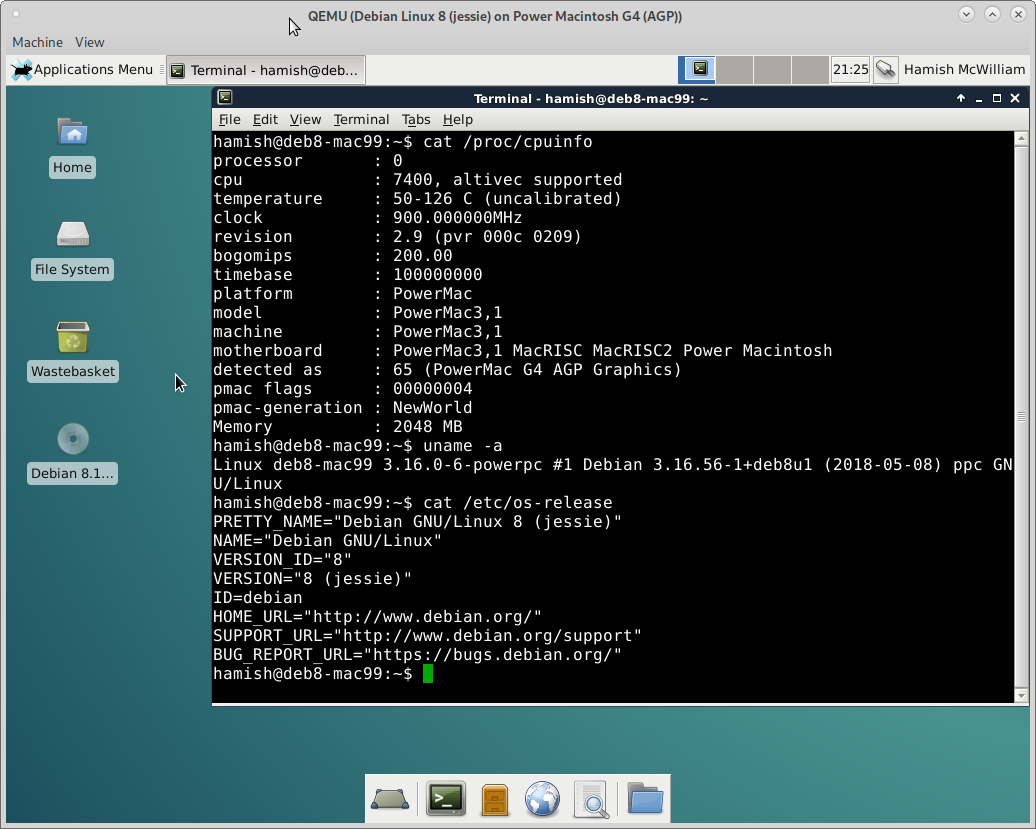
Linux for PowerPC on QEMU (g3beige) - System Information

QEMU g3beige running Debian Linux 8 with XFCE desktop

QEMU & Linux for PowerPC

A recent post (see Linux for PowerPC on QEMU (mac99) - System Information) looked at Linux on QEMU's 'mac99' machine, an emulation of an Apple PowerMac G4 (AGP Graphics). But what about QEMU's other Power Macintosh system?

QEMU

QEMU provides an emulation of the older, Apple Power Macintosh G3 ("beige").

Checking Apple Support, EveryMac.com, Wikipedia the hardware specification for the 'g3beige' would be:

SystemApple Power Macintosh G3 ("beige")
Mac FirmwareOldWorld
CPUPowerPC 750 @ 233, 266, 300, or 333 MHz; upgrade to G4 @ 350 or 400 MHz
RAM32, 64 or 128 MiB (768 MiB max.)
BusPCI
Storagebuilt-in IDE controller; 128GB max. HD
built-in SCSI controller
4GB SCSI, 2x 4GB SCSI or 8GB IDE hard disk(s)
24x ATAPI/IDE CD-ROM
Floppy3.5" 1.44MB
VideoATI 3D Rage II+, ATI 3D Rage Pro, or ATI 3D Rage Pro Turbo, 6 MiB VRAM
AudioWhisper or Wings personality card
Networkbuilt-in RTL-8029(AS) 10 Mb/s 10baseT ethernet
Keyboard & MouseADB

Third-party processor upgrades offered higher spec. G3 and G4 options. Since the emulation will determine the processor speed, we'll go with the default processor.

Emulation Command

For reference the QEMU command used:

qemu-system-ppc \
    --machine g3beige \
    -hda hda_DebianLinux_g3beige.qcow2 \
    -cdrom debian-8.11.0-powerpc-DVD-1.iso \
    -g 1024x768x8 \
    -net nic \
    -net "user,guestfwd=:10.0.2.1:22-cmd:netcat 127.0.0.1 22,hostfwd=::2222-:22" \
    -kernel vmlinux-3.16.0-6-powerpc \
    -initrd initrd.img-3.16.0-6-powerpc \
    -append 'root=/dev/sda3' \
    -name 'Debian Linux 8 (jessie) on Power Macintosh G3 (Beige)'

Note that due to issues with the boot loader, a kernel and ramdisk extracted from the installed system are used to start the system.

Saturday, 21 May 2022

Mandrake Linux 7.2 (Odyssey) on PCem Pentium 75

Mandrake Linux 7.2 KDE desktop

Mandrake Linux

Initially established back in 1998, MandrakeSoft (Wikipedia) was a commercial Linux vendor known for the Mandrake Linux distribution (Wikipedia), after a merger with the Brazilian Linux distribution Conectiva and a dispute over rights to the "Mandrake" name, the company and their Linux distribution changed name from Mandrake to Mandriva.

Mandrake Linux is notable for many improvements to desktop Linux distributions, including improvements to hardware detection and handing, and the use of a graphical installation process. Mandrake was also a pioneer in optimizing their Intel x86 distribution for Pentium or higher processors.

Mandrake Linux 7.2 was released in 2000, and so was a competitor with Red Hat Linux 6.2, and supported Pentium through early Pentium III systems (the Intel Pentium 4 didn't ship until November that year). So it is suitable for comparing our physical Intel Pentium system (tilia) and the PCem emulated equivalent.

PCem

The IBM PC and compatibles emulator PCem supports a range of PC systems, from the original Intel 8088 based IBM PC through to a early 2000s slot 1 based Pentium II system. This includes a couple of systems featuring the Intel 430fx chipset which makes them equivalent to our physical system.

Basing our desired system on tilia and the PCem devices, the target emulated hardware is:

MainboardIntel Advanced/ZP (Zappa); Intel Triton 82430FX PCIset aka. 430FX
CPUIntel Pentium 75
RAM72 MiB (128 MiB max.)
Floppy3.5" 2.88MB
StorageIDE Controller Intel 82371FB aka. PIIX, ATA-2 16 MB/s
IDE hard disk 2048 GB
ATAPI CD-ROM drive
VideoS3 Trio64 based VGA PCI
Network10Mb/s ethernet ISA or 100Mb/s ethernet PCI

Friday, 20 May 2022

Linux for PowerPC on QEMU (mac99) - System Information

QEMU mac99 running Debian Linux 8 - XFCE desktop

Linux for PowerPC

Back in the 1990s Apple, IBM and Motorola (Wikipedia) got together and created the PowerPC architecture (Wikipedia), which would be used in IBM's RS/6000 series systems, Apple's Power Macintosh systems and many Motorola products, including desktop computers and embedded processors. Apple's short lived licensing of Macintosh clones during the mid-1990s, Microsoft Windows NT supporting PowerPC (alongside Alpha, MIPS, and x86), and Apple supporting MkLinux development, drove additional interest in the platform and saw production of affordable PowerPC desktop computers.

While IBM would continue development of PowerPC into their 64-bit POWER architecture, Apple had cut-off the Macintosh clone business in 1997, and then Apple switched away from PowerPC in 2006. Leaving a lot of PowerPC based hardware in circulation, with few operating system options remaining.

Linux on PowerPC has a long, and somewhat complex history, with initial work beginning in 1994, the first Linux distributions appearing in 1996, and PowerPC support being integrated in the mainline Linux kernels with Linux 2.2 in 1999. While the PowerPC architecture has been sunset by many distributions, a few remain.

Debian Linux

Debian added support for PowerPC to its Linux distribution in 2000 with the release of Debian GNU/Linux 2.2 (potato), and while official support for 'powerpc' (32-bit PowerPC and 64-bit big-endian PowerPC) ended in 2020 with Debian 8 (jessie), Debian ports continues to make unstable/testing builds for the 'powerpc' architecture, and has official releases for the 64-bit POWER based systems ('ppc64le').

In the interests of simplicity, reproducibility and ease of comparison, I'm going to use Debian Linux 8 (jessie) for PowerPC, since it has a DVD image available, which means the lack of online repositories won't be a problem and we don't have to consider package version variation.

QEMU

The widespread use of PowerPC processors in computers and embedded systems has driven a need for emulators capable of supporting development and testing for those platforms. The QEMU emulator includes a wide range of processor and system emulations for PowerPC processors, making it a excellent options for these roles at minimal cost.

Monday, 16 May 2022

RedHat Linux 6.2 (Zoot) on PCem Pentium 75

RedHat Linux 6.2 on PCem

X Windows desktop for Red Hat 6.2 (zoot) running on PCem

RedHat Linux

Initially established back in 1994, Red Hat (Wikipedia) is a commercial Linux vendor known for the RedHat Linux, Red Hat Enterprise Linux (RHEL) and Fedora Linux distributions.

RedHat Linux 6.2 was released in 2000, and supported i386 through early Pentium III systems (the Intel Pentium 4 didn't ship until November that year). So it is suitable for comparing our physical Intel Pentium system (tilia) and the PCem emulated equivalent.

PCem

The IBM PC and compatibles emulator PCem supports a range of PC systems, from the original Intel 8088 based IBM PC through to a early 2000s slot 1 based Pentium II system. This includes a couple of systems featuring the Intel 430fx chipset which makes them equivalent to our physical system.

Basing our desired system on tilia and the PCem devices, the target emulated hardware is:

MainboardIntel Advanced/ZP (Zappa); Intel Triton 82430FX PCIset aka. 430FX
CPUIntel Pentium 75
RAM72 MiB (128 MiB max.)
Floppy3.5" 2.88MB
StorageIDE Controller Intel 82371FB aka. PIIX, ATA-2 16 MB/s
IDE hard disk 2048 GB
ATAPI CD-ROM drive
VideoS3 Trio64 based VGA
Network10Mb/s ethernet ISA

Thursday, 12 May 2022

RedHat Linux 5.2 (Apollo) on PCem Pentium 75

RedHat Linux

Initially established back in 1994, Red Hat (Wikipedia) is a commercial Linux vendor known for the RedHat Linux, Red Hat Enterprise Linux and Fedora Linux distributions.

RedHat Linux 5.2 was released in 1998, and supported i386 through early Pentium II systems. So it is suitable for comparing our physical system (tilia) and the PCem emulated equivalent.

PCem

The IBM PC and compatibles emulator PCem supports a range of PC system, from the original Intel 8088 based IBM PC through to a early 2000s slot 1 based Pentium II system. Including a couple of systems featuring the Intel 430fx chipset, making them equivalent to our reference physical system.

The target hardware for emulation is:

MainboardIntel Advanced/ZP (Zappa); Intel Triton 82430FX PCIset aka. 430FX
CPUIntel Pentium 75
RAM72 MiB (128 MiB max.)
Floppy3.5" 2.88MB
StorageIDE Controller Intel 82371FB aka. PIIX, ATA-2 16 MB/s
IDE hard disk 2048 GB
ATAPI CD-ROM drive
VideoS3 Trio64 based VGA
Network10Mb/s ethernet ISA

Tuesday, 10 May 2022

Linux for m68k on QEMU (q800) - System Information

QEMU running Debian Linux unstable (bookworm/sid) for m86k

Motorola 68000 series

Introduced in 1979 the Motorola 68000 series was used in a wide range of computers through the 1980s and 1990s. Initially using a 32-bit instruction set and 32-bit registers combined with a 16-bit data bus, which Motorola dubbed a 16/32-bit processor, later iterations would implement fully 32-bit architectures, while remaining instruction compatible. The initial models provided 8-bit (68008) and 16-bit (68000, 68010) options for the external data bus allowing the use of cheaper support chips in markets that were typically 8-bit and 16-bit dominated in the early 1980s. The first fully 32-bit model, the 68020 introduced in 1984 (a year before Intel launched the 80386), initially appeared in UNIX workstations and its successors would be at the core of home computers in the 1990s. While 68000 series processors no longer appear in desktop systems, they can still be found in embedded applications.

Linux and Motorola 68000 series

Unsurprisingly the Motorola 68000 series was one of the first systems to have a Linux port (see Linux/m68k: Linux on Motorola's 68000 Processor | Linux Journal). Arguably Linux/m68k was the first port of Linux to a non-x86 architecture, initially starting off as a parallel fork of the Linux kernel, and later being incorporated into the mainline kernel, once work to support multiple platforms was in place (see Linus Torvalds 1997 M.Sc. thesis "Linux: a Portable Operating System").

A wide range of Motorola 68000 series systems are supported. Although a memory management unit (MMU) is required for support, which excludes some system variants using processors which didn't include the MMU or where the MMU is non-functional (systems without an MMU may be supported by μClinux (Wikipedia)). Looking around for a Linux distribution with Motorola 68000 series support and which doesn't require too much setup, it looks like Debian is the best bet.

Debian Linux had official release support in Debian 2.0 (Hamm) through Debian 3.1 (Sarge), and has continued to support the architecture through Debian - Ports. Currently a unofficial Linux/m68k network installation image is available for Debian 10 (buster) (https://cdimage.debian.org/cdimage/ports/10.0/m68k/iso-cd/). That sounds good, so let's give it a go...

QEMU

The wide range of systems that used the Motorola 68000 series means there are a lot of emulation options... Since we've looked at QEMU in previous emulation posts, let's see what QEMU offers for these systems...

QEMU has a relatively limited selection of system emulations for the Motorola 68000 series:

Arnewsh Inc. SBC5206an5206evaluation board
NXP MCF5208 Evaluation Boardmcf5208evbevaluation board
NeXT NeXTcube (Wikipedia)next-cubeUNIX workstation
Apple Macintosh Quadra 800 (Wikipedia)q800desktop system

Note: with QEMU 6.0 support has been added for a virt machine that is more flexible than systems considered here (see QEMU M680x0 support [PDF]).

The QEMU wiki has a description of how to install Linux on the q800 system (Documentation/Platforms/m68k - QEMU), so that sounds like a good place to begin...

Checking Apple Support, EveryMac.com, Wikipedia the hardware specification for the 'q800' would be:

SystemApple Macintosh Quadra 800
CPU68040 @ 33 MHz, includes PMMU & FPU
RAM8 MiB (136 MiB max.)
Floppy3.5" 1.44MB
StorageEmulex SCSI Processor (ESP236) controller
SCSI internal hard disk 230 MB or 500 MB
SCSI 2x CD-ROM drive
Videoframebuffer, 512 KiB or 1.0 MiB
NetworkSONIC (DP83932) 10Mb/s ethernet AAUI-15
Keyboard & MouseADB

Third-party processor clock upgrades could get the 68040 to 40 MHz or 50 MHz, and there was a PowerPC 601 @ 100 MHz upgrade processor option.

Since QEMU is not limited by the physical hardware, there is the option of having more memory than the system could support. For 'q800' it turns out that the maximum RAM is around 1,000 MiB (with 1.0 GiB problems appear).

Thursday, 14 April 2022

Slackware Linux 3.0 on a PCem Pentium 75

PCem Slackware 3.0 X-windows

Slackware

Established back in 1993, Slackware (The Slackware Linux Project; Wikipedia) is the oldest surviving Linux distribution...

Slackware Linux 3.0 was the first Slackware release to have an official CD-ROM distribution and support installation from CD-ROM. Released in November 1995, the same month as the Pentium Pro. So complete system support is limited to i386, i486 and early Pentium systems.

Fortunately I have a Pentium based system that consists of hardware from this era: tilia. And that machine can be approximated using an Intel 430fx based system in PC emulators such as PCem.

PCem

The IBM PC and compatibles emulator PCem supports a range of PC system, from the original Intel 8088 based IBM PC through to a early 2000s slot 1 based Pentium II system. This includes a couple of systems featuring the Intel 430fx chipset which makes them equivalent to our physical system.

So the target emulated hardware is:

MainboardIntel Advanced/ZP (Zappa); Intel Triton 82430FX PCIset aka. 430FX
CPUIntel Pentium 75
RAM72 MiB (128 MiB max.)
Floppy3.5" 2.88MB
StorageIDE Controller Intel 82371FB aka. PIIX, ATA-2 16 MB/s
IDE hard disk 2048 GB
ATAPI CD-ROM drive
VideoS3 Trio64 based VGA
Network10Mb/s ethernet ISA

Monday, 23 August 2021

Raspberry Pi OS on QEMU raspi2b - System Information

Raspberry Pi OS

The popular Raspberry Pi (Wikipedia) is often used with a tuned Linux distribution: Raspberry Pi OS (formerly Raspbian), which is based on Debian Linux.

QEMU

The system emulator QEMU provides machine profiles for a selection of Raspberry Pi models:

The 32-bit ARM models, ARMv6 & ARMv7:

$ qemu-system-arm -machine help | grep rasp
raspi0               Raspberry Pi Zero (revision 1.2)
raspi1ap             Raspberry Pi A+ (revision 1.1)
raspi2               Raspberry Pi 2B (revision 1.1) (alias of raspi2b)
raspi2b              Raspberry Pi 2B (revision 1.1)

The 64-bit ARM models, ARMv8:

$ qemu-system-aarch64 -machine help | grep rasp
raspi0               Raspberry Pi Zero (revision 1.2)
raspi1ap             Raspberry Pi A+ (revision 1.1)
raspi2               Raspberry Pi 2B (revision 1.1) (alias of raspi2b)
raspi2b              Raspberry Pi 2B (revision 1.1)
raspi3ap             Raspberry Pi 3A+ (revision 1.0)
raspi3               Raspberry Pi 3B (revision 1.2) (alias of raspi3b)
raspi3b              Raspberry Pi 3B (revision 1.2)

The 64-bit emulation presumably includes the 32-bit models in order to allow for hypothetical upgraded versions of these systems by swapping the ARM processor core. This also provides support for the revisions of the Raspberry Pi 2B, the original board used a BCM2836 SoC with a 32-bit ARM v7 processor, but later versions of the 2B board used a BCM2837 with a 64-bit ARM v8 processor.

These options cover three processors:

  • Broadcom BCM2835 SoC in the Zero and A+
    • ARM1176JZF-S @ 700 Mhz core, 32-bit ARMv6
  • Broadcom BCM2836 SoC in the 2B
    • ARM Cortex-A7 @ 900 MHz, quad-core, 32-bit ARMv7
  • Broadcom BCM2837 SoC in the 3A+ and 3B
    • ARM Cortex-A53 @ 1.2 GHz or 1.4 GHz, quad-core, 64-bit ARMv8

That is three generations of the ARM architecture and coverage of the older models.

Sunday, 15 August 2021

NetBSD/hppa on QEMU - System Information

NetBSD on PA-RISC

Originally inspired by OpenBSD/hppa the current NetBSD/hppa started as a port for HP 9000/700 systems and carried the name NetBSD/hp700. An initial experimental source release with NetBSD 2.0 in 2004, was followed by a binary release with NetBSD 3.0 in 2005. For NetBSD 7.0 in 2021 the port adopted the 'hppa' architecture name. The port now covers most PA-RISC HP 9000 systems, albeit in 32-mode.

Platform

HP developed the Precision Architecture (HP-PA or PA-RISC) RISC processor during the early 1980s in order to consolidate its compute platforms on to two architectures: Intel x86 and HP PA-RISC. The PA-RISC based HP 9000 series 700 entered the market in 1991

Emulator and Platform

The QEMU system emulator provides a 32-bit PA-RISC emulation based on the HP Visualize B160L (9000/778), a 1996 HP-UX workstation. From HP Visualize B132L, B160L, B180L PA-RISC Workstations - OpenPA.net the B160L system specifications are:

  • CPU: PA-7300LC 160 MHz
  • RAM: 32 MiB to 1.5 GiB max.
  • Bus: GSC, EISA, PCI
  • Storage controllers:
    • NCR 53C710 narrow SCSI-2
    • NCR 53C720 Fast-Wide HVD SCSI-2
  • Network interface: Intel 82596CA 10 Mb/s ethernet
  • Graphics: Visualize-EG (Graffiti) 2MB
  • Audio: Harmony

The emulated system doesn't implement the audio, ethernet or SCSI controllers (yet), instead replacing the SCSI controllers and ethernet interface with PCI devices to provide the same functionality:

  • CPU: one (or more) PA-7300LC at 250 MHz
  • RAM: 512 MiB default, up to 3.0 GiB
  • Bus: GSC, EISA, PCI
  • Storage controllers: Symbios Logic 53c895 Fast Wide LVD SCSI-2, PCI
  • Network interface: DEC Tulip 21142/43 100 Mb/s ethernet, PCI
  • Graphics: HPA208LC1280 aka. Artist

The addition of multi-processor (SMP) support diverges from the source workstation, but provides an alternative means for increasing the system performance.

Sunday, 8 August 2021

Slackware Linux 3.0 on QEMU

Slackware

Established back in 1993, Slackware (The Slackware Linux Project; Wikipedia) is the oldest surviving Linux distribution...

Slackware Linux 3.0 was the first Slackware release to have an official CD-ROM distribution and support installation from CD-ROM. Released in November 1995, the same month as the Pentium Pro, it doesn't have support for a lot of the more modern hardware emulated by QEMU...


QEMU

The default QEMU i386 system emulation ('pc') is based on Intel's "Natoma" (Intel 440FX & PIIX3) chipset for Pentium Pro and Pentium II processors, which was released in 1996 (List of Intel chipsets - Wikipedia):

  • Model: "pc" - Intel 440FX & PIIX3 "Natoma"
  • CPU: "qemu32" - QEMU Virtual CPU (default)
  • RAM: 128 MiB default, 2 GiB max.
  • Bus: PCI and ISA
  • Storage controller: IDE (PIIX3)
  • Network interface: "e1000" - Intel 82540EM Gigabit Ethernet Controller, 1,000 Mb/s ethernet
  • Graphics: "std" - Standard VGA (with Bochs VBE)

Since the kernels included with Slackware 3.0 are older than this, they don't recognize the hardware and use generic methods to run on the system. Distributions based on the Linux 2.0 series or later kernels would be a better choice for the 'pc' machine (Linux Version 2.0 | Linux Journal).

Fortunately QEMU has a generic ISA based PC system profile ('isapc') which provides an option that is more in keeping with the hardware available when Slackware 3.0 was released:

  • Model: "isapc" - ISA bus PC
  • CPU: "486" - Intel i486DX/4
  • RAM: 128 MiB default, 2 GiB max.
  • Bus: ISA
  • Storage controller: IDE
  • Network interface: "ne2k_isa" - NE2000 ISA, 10 Mb/s ethernet (IRQ 9, I/O 0x300)
  • Graphics: "cirrus" - Cirrus GD-5446 VGA ISA
This isn't ideal, given that PCI based 486 and Pentium based systems existed at the time, but QEMU doesn't provide the appropriate chipsets for those systems, so exploration of those options will have to be on real hardware, or using other emulators (e.g. Bochs, PCem, etc.).

Sunday, 25 July 2021

HP-UX 11i v1 (32-bit PA-RISC) on QEMU - System Information

HP 9000 Family

In the early 1980s Hewlett-Packard (HP) introduced the HP 9000 family (Wikipedia), the initial offerings were re-badges of existing workstation lines featuring machines based on the Motorola 68000 and HP FOCUS processors. In 1991 the HP 9000/700 series was introduced, based on HP's Precision Architecture RISC processor (HP-PA or PA-RISC) (Wikipedia). The earlier 32-bit PA-RISC 1.0 processors had appeared in HP's mainframe and server systems back in the mid-1980s, but this was the first appearance of PA-RISC in a workstation line, and used the improved PA-RISC 1.1 processors. This marked the final stage in the consolidation of HP's non-x86 computer lines on to a single processor architecture. In 1996 HP introduced its first systems using the 64-bit PA-RISC processors, including the HP Visualize C160 and C180 workstations (both model 9000/780).

HP-UX 11i CDE logon screen in QEMU

Other than some early systems, and some systems based on the acquired technologies from Apollo Computers (these could also run Apollo Domain/OS), the HP 9000 line shipped running versions of HP's UNIX operating system: HP-UX (Wikipedia). Initially based on AT&T UNIX System III, and later UNIX System V, HP-UX was a major commercial UNIX from the 1980s through the 2000s. The rise of the open source UNIX-like operating systems and the market reception of Itanium (IA-64) servers would ultimately see HP-UX relegated to a maintenance role, with the last release being HP-UX 11i v3 in 2007, the last update in 2020, and support ending on PA-RISC in 2021 and on IA-64 in 2025.

QEMU

Emulates a HP 9000/778/B160L , normally known as a HP Visualize B160L workstation (HP Visualize B132L, B160L, B180L PA-RISC Workstations - OpenPA.net).

Emulated system specification:

  • CPU: 1x PA-7300LC at 250 MHz (32-bit PA-RISC)
  • RAM: default 512 MiB, up to 3.0 GiB (hardware supported up to 1.5 GiB)
  • Disk controller(s): SCSI C895 Fast Wide LVD (Symbios Logic 53c895 chipset)
  • Network controller(s): Ethernet (DEC Tulip 21142/43)
  • Graphics: HPA208LC1280 aka. Artist.

Since the B160L is based on a 32-bit PA-RISC 1.1 processor, the latest version of HP-UX that can be used is HP-UX 11i v1 (see HP-UX Unix Operating System for PA-RISC - OpenPA.net), later versions only support 64-bit PA-RISC and Itanium systems.

Monday, 5 July 2021

Linux for PA-RISC (32-bit) on QEMU - System Information

HP PA-RISC

In the mid-1980s Hewlett-Packard (HP) introduced the first version of its Precision Architecture RISC processor (HP-PA or PA-RISC) (Wikipedia) in its mainframe and server product lines. In 1991 the HP 9000/700 series was introduced based on the improved PA-RISC 1.1 processors. In 1996 HP introduced its first systems using the 64-bit PA-RISC 2.0 processors, including the HP Visualize C160 and C180 workstations (both model 9000/780).

In the 1990s PA-RISC was one of the main RISC processors seen in UNIX workstations, along with AXP Alpha, PowerPC/POWER, SPARC and MIPS. The phasing out of the PA-RISC systems, in favor of Itanium (IA-64) based HP Integrity systems (Wikipedia) during the 2000s mean there is an interest in replacing ageing hardware with emulation options.

As well as the proprietary UNIX from HP (HP-UX), PA-RISC systems can also run the Linux, NetBSD and OpenBSD open source operating systems.

Linux on PA-RISC

The Linux on PA-RISC project added support for PA-RISC system starting with Linux 2.6, and the Debian and Gentoo Linux distributions have support for PA-RISC.

While official support for PA-RISC ended with Debian Linux 5 (lenny), the Debian for PA-RISC port does provide an un-official  network installation CD image for the current release. However the current Debian Linux for PA-RISC ports repository is for Debian Linux "unstable" (sid), which can cause problems with installation.

For the purposes of this exploration I'm going to use the Debian Linux 5 (lenny) distribution DVD, this means the results presented here will be easily reproducible. For those curious about PA-RISC Debian Linux 10, there is a pre-made disk image at Qemu - Linux PARISC Wiki that might help.

Sunday, 27 June 2021

HP Tru64 UNIX on AlphaVM-Free - System Information

AlphaVM-Free

A commercial Alpha AXP system emulator from EmuVM, the AlphaVM family of system emulators provide a means to emulate members of the Tsunami family of Alpha based systems from Compaq and HP. Mainly targeted at providing a migration option for existing Alpha systems running OpenVMS or Tru64 UNIX, allowing existing applications to be moved to newer, and potentially more efficient, hardware. A free version of AlphaVM (AlphaVM-Free) was offered as an evaluation and hobbyist product complementing the supported commercial offering (AlphaVM-Pro). Apparently due to licence abuse (see The sad state of Alpha emulators (for OpenVMS) - Raymii.org) the free version has been since replaced with a low cost option (AlphaVM-Basic).

To have a look at the emulator's capabilities and how well it manages to run HP Tru64 UNIX, I've setup a legacy AlphaVM-Free system in a Debian Linux 10 (buster) virtual machine and installed HP Tru64 UNIX 5.1B. Since all versions of AlphaVM are related the other versions will show similar behavior, although there is some additional flexibility with tuning the emulation available in the commercial product.

Note that AlphaVM requires the CMPXCHG16B instruction to be available on the host. In my case this meant I had to update the VirtualBox configuration for the Debian Linux 10 host virtual machine to allow access to this instruction (see virtualbox.org: View topic - hot to enable CMPXCHG16B instruction).

Friday, 25 June 2021

Linux for SPARC64 on QEMU sun4u - System Information

Linux for SPARC

The SPARC processor (Wikipedia) was the third processor to be supported in the Linux kernel (after x86 and Alpha) back in the mid 1990s. In his 1997 M.Sc. thesis: "Linux: a Portable Operating System", Linus Torvalds discussed the integration of Alpha and SPARC into the Linux kernel and the challenges of developing a portable operating system.

Looking for early Linux distributions supporting SPARC finds:

  • RedHat Linux 4.0 released 3-Oct-1996: 2.0.18 kernel supporting sun4c and sun4m.
  • RedHat Linux 6.0 released 26-Apr-1999: 2.2.5 kernel supporting sun4c, sun4m and sun4u
  • Debian Linux 2.1 (slink) released 9-May-1999: 2.0.35 kernel for sun4c and sun4m, and 2.2.1 kernel for sun4u

These Linux distributions were targeted at Sun's SPARC systems and did not support SPARC systems from other vendors, unless they were clones of Sun's systems.

In 1987 Sun Microsystems introduced its first 32-bit based SPARC systems, and Sun introduced its first 64-bit SPARC (UltraSparc) systems in late 1995 with the Ultra 1 and Ultra 2 workstations and their server variants, the Ultra Server 1 and Ultra Server 2.

The 64-bit SPARC specification had been released by SPARC International in 1993 and HAL Computer Systems (Wikipedia), a subsidiary of Fujitsu, brought the first SPARC64 workstations to market in 1995, with the release of the HALstation 300 series systems.

Monday, 21 June 2021

Linux for Alpha on AlphaVM-Free - System Information

AlphaVM-Free & Alpha Linux

The AlphaVM family of system emulators from EmuVM, provide a means to emulate members of the Tsunami family of Alpha based systems from Compaq and HP. Mainly targeted at providing a migration option for existing Alpha systems running OpenVMS or Tru64 UNIX, this emulator is also capable of running Linux for Alpha.

The Alpha (Wikipedia) was the first non Intel x86 platform to have support integrated into the Linux kernel back in the mid 1990s. Linus Torvalds discusses the integration of Alpha and SPARC into Linux and the challenges of developing a portable operating system in his 1997 M.Sc. thesis: "Linux: a Portable Operating System". While the retirement of Alpha systems by Compaq and HP means the remaining hardware is aging, and Linux has been ported to many more systems since, there are still some use cases for Linux on Alpha. But moving away from potentially unreliable and increasingly uncommon hardware has become very desirable. One option for accomplishing this is using a system emulator.

The AlphaVM system emulator is one such possibility and a free version of AlphaVM (AlphaVM-Free) was offered as an evaluation and hobbyist product. This complemented the supported commercial offering (AlphaVM-Pro) which provides increased capabilities and full support. Apparently due to licence abuse (see The sad state of Alpha emulators (for OpenVMS) - Raymii.org) the free version has been since replaced with a low cost option (AlphaVM-Basic).

To have a look at the emulator's capabilities and how well it manages to run Linux, I've setup a legacy AlphaVM-Free system in a Debian Linux 10 (buster) virtual machine and installed Debian Linux 5 (lenny) from the distribution DVD.

Note that AlphaVM requires the CMPXCHG16B instruction to be available on the host. In my case this meant I had to update the VirtualBox configuration for the Debian Linux 10 host virtual machine to allow access to this instruction (see virtualbox.org: View topic - hot to enable CMPXCHG16B instruction).

Monday, 14 June 2021

HP Tru64 on FreeAXP - System Information

FreeAXP

Migration Specialties International, Inc. provide a services for the maintenance and migration of OpenVMS and Tru64 operating system environments. Part of their offering uses system emulation to provide an option to migrate from aging hardware on to modern systems. As an evaluation and hobbyist tool, they also provide a free version of their system emulator system: FreeAXP which emulates a DEC Alpha (AXP) based AlphaServer 400 with the specification:

  • RAM: 32MB to 128MB
  • Up to 7 SCSI disks
  • Up to 2 network interfaces
  • 2 serial ports (used for system console)
  • Capable of running OpenVMS or Tru64

So having downloaded and installed the emulator, I've configured a emulated system for testing with Tru64:

  • CPU: a DECchip 21064 (EV4) Alpha processor
  • RAM: 128 MB
  • SCSI controller: KZPAA (53c810) - narrow SCSI, max. 7 devices
    • Id 0: RZ40L SCSI Hard disk - 8 GB
    • Id 6: RRD42 SCSI CD-ROM drive - mapped to system optical drive
  • Network interface: DE500 (21143)

FreeAXP uses a version of the SRM firmware from the AlphaServer 400, which can tell us a bit about the system before we install an operating system.

Monday, 7 June 2021

Linux for Alpha on QEMU - System Information

Linux for Alpha

A long time ago, the Digital Equipment Corporation's (DEC) Alpha processor aka. Alpha AXP (Wikipedia) looked to be the future. It dominated the super computer listings, spawned a number of workstation, server and OEM systems, and there was even a MS Windows port. In those heady days it also happened to find itself the target of the first non-x86 port of the Linux kernel. A porting effort at DEC was described by Jim Paradis in a series of Linux Journal Articles (1, 2, 3) back in 1995, and Linus Torvalds in his 1997 M.Sc. thesis: "Linux: a Portable Operating System", discusses the portability of the Linux kernel using the challenges encountered in adding support for Alpha and SPARC as examples.

The Alpha ultimately lost out to the joint HP & Intel Itanium business case when Compaq bought DEC in 1998, with the Alpha IP being sold to Intel in 2001. Compaq merged with HP in 2002, and HP continued marketing Alpha based systems until 2007 and supported the hardware until 2012.

As such there is a desire to replicate Alpha environments on more modern hardware. For some this is a way to run applications that were built for Alpha, and may even be exclusive to that platform. For others its a way to explore the behaviours of older systems and maybe learn from the differences. The QEMU system emulator provides an emulation of an Alpha based system capable of running Linux. Currently there are few Linux distributions that support Alpha...